Human review points
Silica Lab assumes some decisions should stay human: access expansion, deployment changes, public release, and sensitive escalation.
 Discuss a deployment
Safety
Silica Lab is designed around explicit boundaries. The most important public promise is not “power”; it is clarity about what the environment permits, reviews, and blocks.
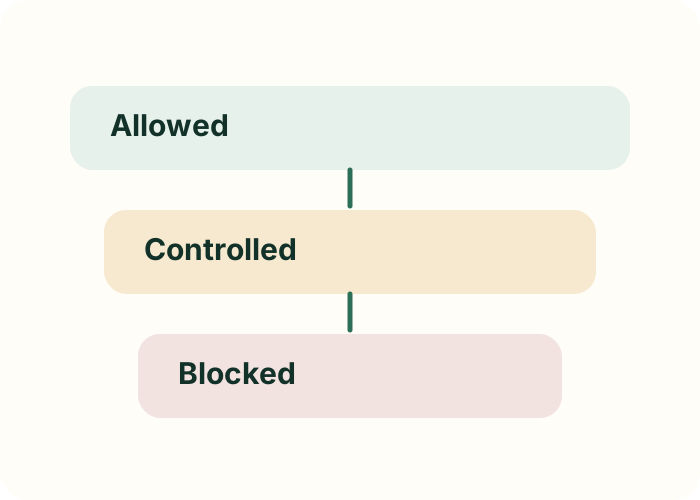
Boundary model
| Boundary | Meaning | Examples |
|---|---|---|
| Allowed | Routine work that suits the route and does not exceed the intended risk level. | Normal classroom tools, guided coding, approved devices, scoped practice activity. |
| Controlled | Activity that may be appropriate, but only with explicit review, configuration, or operator awareness. | Higher-trust tooling, publishing actions, expanded access, environment changes, builder-grade workflows. |
| Blocked | Activity that is unsafe, unnecessary, unmanaged, or outside the scope of the deployment. | Credential sharing, raw private-data exposure, unmanaged production access, reckless public release. |
Silica Lab assumes some decisions should stay human: access expansion, deployment changes, public release, and sensitive escalation.
Enough evidence is kept to explain the route, the decision, and the next step without creating a surveillance theatre posture.
The same software or workflow may be suitable in one deployment and inappropriate in another. Boundaries move with maturity and context, not ego.
When something falls outside the expected route, the response is escalation and review, not denial that the boundary exists.
That is why Silica Lab belongs inside the trust architecture of X7 rather than being sold as an ungoverned playground.
Next step