Profiles and browser separation
Profiles reduce accidental crossover between school, personal, testing, and operational work.
 Discuss a deployment
Software
Silica Lab is not a “more software equals better” model. The software layer exists to support the learning or operational task without collapsing the boundary model.
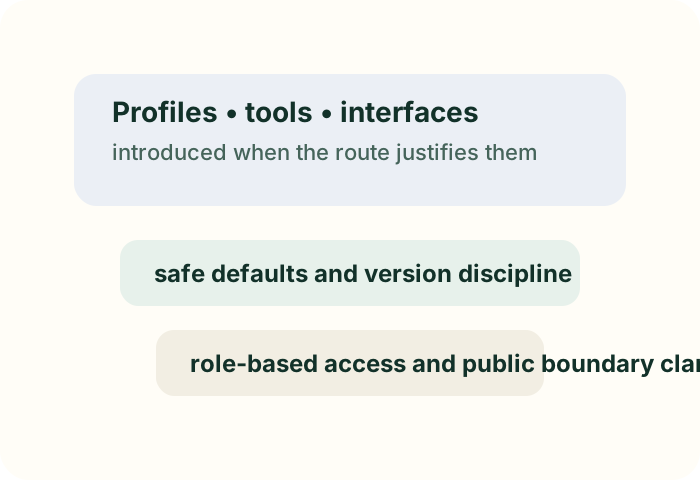
Profiles reduce accidental crossover between school, personal, testing, and operational work.
Editors, docs, spreadsheets, robotics tools, and AI interfaces are chosen by route rather than by trend.
The goal is predictable behavior, not silent drift caused by unmanaged updates or tool sprawl.
Roles and permissions
| Role | Default scope | Notes |
|---|---|---|
| Learner | Guided access | Tools exposed only to the degree needed for the phase and task. |
| Teacher or facilitator | Managed classroom control | Can direct activity, monitor progress, and maintain consistency. |
| Operator | Configuration and review | Owns deployment hygiene, configuration changes, and boundary enforcement. |
| Adult builder | Scoped advanced tooling | May use more powerful workflows, but still inside a review-aware route. |
The public site explains categories and policies. It does not publish private credential flows, internal environment details, or any configuration that would weaken the operating boundary.
That separation is intentional. Trust is improved by clarity, not by reckless oversharing.
Next step